How the DPI Scheme Supports India’s Clean Energy Transition with CBG?

 03 Oct, 2025
India is slowly moving towards a new energy revolution. The country is focusing on reducing pollution and its dependence on fossil fuels. This transformation is compressed biogas (CBG), an environmentally friendly and sustainable alternative fuel. Produced using materials such as agricultural waste, animal dung, and food waste. This fuel is equally effective for strengthening the rural economy and the urban industrial sectors.
However, reliable infrastructure is needed to transport this fuel from the production center to the industries and cities. The role of pipeline infrastructure is important here. Without pipelines, it is not possible to reach the users of the produced biogas. The Government of India has launched the Development of Pipeline Infrastructure (DPI) scheme to solve this problem. This scheme stands as a strong transportation network that will act as the backbone for CBG distribution.
Why is CBG Pipeline Infrastructure Needed in India?
India’s rapid industrialization and urbanization are increasing air pollution and dependence on fuel imports. The use of fossil fuels is causing environmental damage and also creating foreign exchange pressure. So, compressed biogas (CBG) has emerged as a unique solution.
CBG is a renewable and safe fuel. It is produced using agricultural residues, animal dung, and food waste. So, the problem of waste management is reduced, and farmers also get additional income. Due to its eco-friendly properties, it can be an alternative to fossil fuels.
However, the primary challenge is to deliver the produced gas to cities, industrial areas, and the transport sector. An effective supply of this fuel is not possible without pipeline infrastructure. So, the government has launched the Development of Pipeline Infrastructure (DPI) scheme as a solution. Through this scheme, CBG plants are being connected to the City Gas Distribution (CGD) network and the national gas grid. This will ensure an uninterrupted supply of fuel.
Objectives of the DPI Scheme
The Development of Pipeline Infrastructure (DPI) Scheme is a key part of India’s clean energy transformation. The objectives of the scheme are clearly and effectively defined.
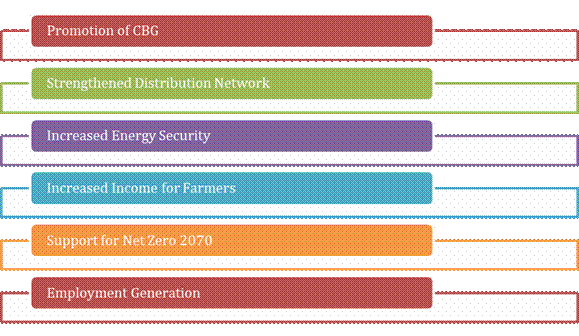
Promotion of CBG: Promote compressed biogas as a green and reliable fuel.
Strengthened distribution network: Ensure uninterrupted supply from CBG plants to cities and industrial areas.
Increased energy security: Make the country energy self-reliant by reducing imports.
Increased income for farmers: It generates additional income and strengthens the rural economy through the use of agricultural waste.
Support for Net Zero 2070: Contribute to reducing carbon emissions by reducing fossil fuels.
Employment generation: Create new job opportunities in the construction, maintenance, and operation of pipelines.
These prove the DPI Scheme is the foundation for India’s eco-friendly and sustainable energy future.
Institutional Framework for Implementation of DPI Scheme
A clear institutional framework has been developed for the effective implementation of the DPI Scheme. Here, four important bodies perform their specific responsibilities.
1. Steering Committee (SC): Policy direction
- It is headed by the Secretary, Ministry of Petroleum and Natural Gas.
- Representatives of various ministries are involved.
- It monitors the progress of the scheme implementation and provides policy guidance.
2. Project Approval Board (PAB): Final approval
- This board gives final approval for the implementation of the project.
- The projects recommended by the PAC are scrutinized and approved.
3. Project Appraisal Committee (PAC): Appraisal and recommendations
- Reviews the project proposals in detail.
- Sends recommendations to the PAB for approval.
- Monitors the progress of ongoing projects.
4. Project Management Agency (PMA): Day-to-day operation
- Manages the application process through the online portal.
- Monitoring the verification of projects, accounting of financial assistance, and implementation.
- Acts as a bridge between the beneficiaries and the central agency.
Ensuring Transparency
Transparency is maintained in the entire process through a digital platform, third-party audit, and field observation.
Components of the DPI Scheme
The DPI scheme has two main components. Each component is designed to meet specific needs, and different agencies can work under it.
Component I: CBG Injection to City Gas Distribution (CGD) Network
Objective and Benefits
The main objective of this component is to ensure direct fuel supply from CBG plants to the CGD network.
- To reduce pollution by providing clean fuel to urban and industrial areas.
- To create additional income opportunities for farmers.
- Funding Pattern and Financial Assistance
- Maximum 50% assistance or ₹50 lakh per km for steel pipelines.
- Maximum ₹7.5 lakh per km for MDPE pipelines.
- Maximum assistance of Rs. 28.75 crore per project (up to 75 km).
Eligibility Criteria
- CBG plant with a production capacity of at least 2 tonnes per day (TPD).
- Must be registered on the Gabadhan portal.
- Must have an agreement with the CGD entity, which includes a commitment of at least 50% gas offtake.
Component II: CBG Injection to Gas Pipeline Network
Objective and Support
Support is provided to Gas Pipeline Operators (GPOs) for connecting CBG clusters or plants with the National Gas Transmission Pipeline.
Funding Limit
- Support up to a maximum of Rs. 75 lakh per km for steel pipelines.
- Rs. 7.5 lakh per km for MDPE pipelines.
- Financial assistance up to a maximum of 75 km is applicable.
Milestone-based disbursement and conditions
- 10% advance payment at the time of sanction (subject to bank guarantee).
- 40%-50% release of funds after 50% of work is completed.
- Final disbursement of funds is ensured after project commissioning and at least 50% utilization for a period of three months.
Eligibility
- GPOs approved by the PNGRB or operating independent pipelines.
- Plants with a production capacity of 10 TPD or more.
- The plant should be registered on the GOBARdhan portal and have a 50% offtake agreement with the GPO.
Beneficiary Responsibilities and Compliance
Beneficiaries under the DPI scheme have certain responsibilities. CBG producers, CGD companies, and gas pipeline operators are required to ensure safe and effective use of the pipeline. They are required to maintain proper maintenance, repair, and safety measures.
Regulatory compliance includes safety standards, tariff agreements, and effective operational guidelines. All activities must be conducted in accordance with the rules prescribed by the relevant regulatory authorities.
The pipeline can be used for the transportation of biogas. Its use for any other purpose is prohibited. In case of mismanagement or violation of rules, the financial assistance may be withdrawn. Properly fulfilling these responsibilities ensures the long-term and effective operation of the project.
Financial Assistance and Eligibility Criteria
Financial assistance under the DPI scheme is provided on a cost-sharing basis. A maximum of 50% assistance is provided for the construction of the pipeline. The assistance is available up to ₹50-75 lakh per km for steel pipelines and a maximum of ₹7.5 lakh per km for MDPE pipelines. A project can be covered up to a maximum of 75 km.
The eligibility criteria include the production capacity of the CBG plant (minimum 2 TPD or 10 TPD, depending on the component), registration on the GOBARdhan portal, and at least 25% physical progress of the project under construction. It is also mandatory to have a 50% offtake agreement with CGD or GPO.
The application process is completely through the online portal. The last date for submission of the application is 30th September 2025. After the initial verification, the project implementation starts once the approval of PAC and PAB is received.
Key Benefits of The DPI Scheme
Given below are the benefits of the DPI scheme-
Environmental Benefits
- Air pollution and carbon emissions are reduced.
- Crop residues and cow dung are properly utilized.
- Flaring of waste is prevented.
Economic Benefits
- Farmers earn additional income from agricultural waste.
- New employment opportunities are created in the rural economy.
- Supply of affordable and clean fuel is ensured for the industrial and transport sectors.
Robust Energy Supply Chain
- Permanent pipeline infrastructure is created for the CBG supply.
- Regular and uninterrupted energy reaches cities and industrial areas.
- Sustainable development and green economy
- Dependence on fossil fuels is reduced.
- Helps India achieve the Net Zero 2070 goal.
- Takes the country on the path of energy security and self-reliance.
Future Vision for India’s DPI and CBG
The DPI scheme is laying a solid foundation for India’s long-term energy transition. The initiative will take on a broader form in the coming days.
Potential Growth: Thousands of CBG plants are targeted to be connected to the national energy network through pipelines by 2030.
Integration with City Gas Grid: Integration with the CGD network and national gas pipelines will create a seamless supply chain.
Energy Self-Reliance: The country will achieve energy security by reducing fossil fuel imports.
Emission Reduction Target: Carbon emissions will be reduced significantly, in line with the Net Zero 2070 target.
Private Participation: Private investors will participate in infrastructure development more.
Carbon credit trading is a method to slow down global warming.
To Wrap Up
The DPI scheme is one of the pillars of India’s clean energy future. This initiative is bringing CBG to cities and industries, playing a significant role in increasing farmers’ income, developing the rural economy, and protecting the environment. This is a major step in India’s journey of sustainable development.
Now is the time for entrepreneurs, industries, and other stakeholders to take advantage of this scheme. It is a responsibility to build a cleaner world for future generations.
Enterclimate is here for you. Contact our expert team today to get professional assistance in DPI scheme application, regulatory compliance, and pipeline infrastructure development.
Frequently Asked Questions about DPI Scheme
The DPI Scheme is a central government initiative to connect CBG plants to the City Gas Distribution (CGD) network and the national gas pipeline. It aims to provide financial support, provide clear guidelines for project implementation, and ensure safe and efficient transportation of biogas from the production plant to the consumers.
CBG plant operators, project developers, and Gas Pipeline Operators (GPOs) can apply for this scheme. The CBG plant must be registered on the Govardhan portal and meet the minimum production capacity. The GPO must be approved by the PNGRB or operate its own captive pipeline.
Under Component I, assistance is provided for laying pipelines from CBG plants to the CGD network. The maximum assistance is 50% of the project cost or a maximum of ₹50 lakh per km for steel pipelines and ₹7.5 lakh for MDPE pipelines. The maximum assistance limit is ₹28.75 crore.
Component II is mainly for Gas Pipeline Operators (GPOs). Through it, CBG clusters or plants are connected to the national transmission pipeline. Financial assistance is provided up to 50% of the project cost, whereas maximum assistance of ₹75 lakh per km is available for steel pipelines. Here, the plant requires a minimum production capacity of 10 TPD.
The minimum production capacity of CBG plants should be 2 TPD (Component I) or 10 TPD (Component II). The plant should be registered on the Govardhan portal, and if under construction, there should be at least 25% physical progress. There should also be at least a 50% offtake agreement with CGD or GPO.
In the DPI scheme, the money is disbursed in stages. First, a 10% advance is given on the basis of a bank guarantee. When 50% of the construction is completed, 40-50% of the money is released. The remaining money is given after commissioning. However, the condition is that proof of 50% pipeline utilization for at least three months must be provided.
The beneficiaries have to maintain the safety of the pipeline, comply with environmental and technical standards, and use the pipeline only for biogas transportation. They also have to follow the maintenance, safety, and regulatory guidelines given by the government. If these are not followed, the financial assistance given by the government may be withdrawn.
Farmers can supply crop residues, cow dung, and agricultural waste to the CBG plant. So, they get an opportunity to earn additional income. The Air pollution is reduced by reducing stubble burning. This process creates a sustainable source of income for farmers and strengthens the rural economy.
The DPI scheme is directly linked to India’s Net Zero 2070 goal. It reduces the use of fossil fuels and promotes the use of renewable fuels like CBG. This reduces carbon emissions, creates new jobs, and strengthens the supply chain of green energy. So, the scheme is the cornerstone of India’s clean energy roadmap.
The application for financial assistance under the DPI scheme has to be made through the online portal. The last date for applying is 30 September 2025. After applying, the PMA verifies the information, the PAC reviews it, and the PAB gives final approval. The application process is usually completed within two months.
Categories
Latest Post










Popular Renewable energy sources available in Rural India
India, known for its rapid economic growth and substantial manufacturing sector, possesses abundant renewable energy potential through solar, wind, and hyd...Read More
Schemes under the Bihar Renewable Energy Development Agency
India houses 15% of the global population and boasts one of the most rapid economic expansions. The escalating GDP translates to increased earnings for the...Read More